
Roll down
Gravity trades height for speed on the way down. Bent knees leave room to extend on the next wall.
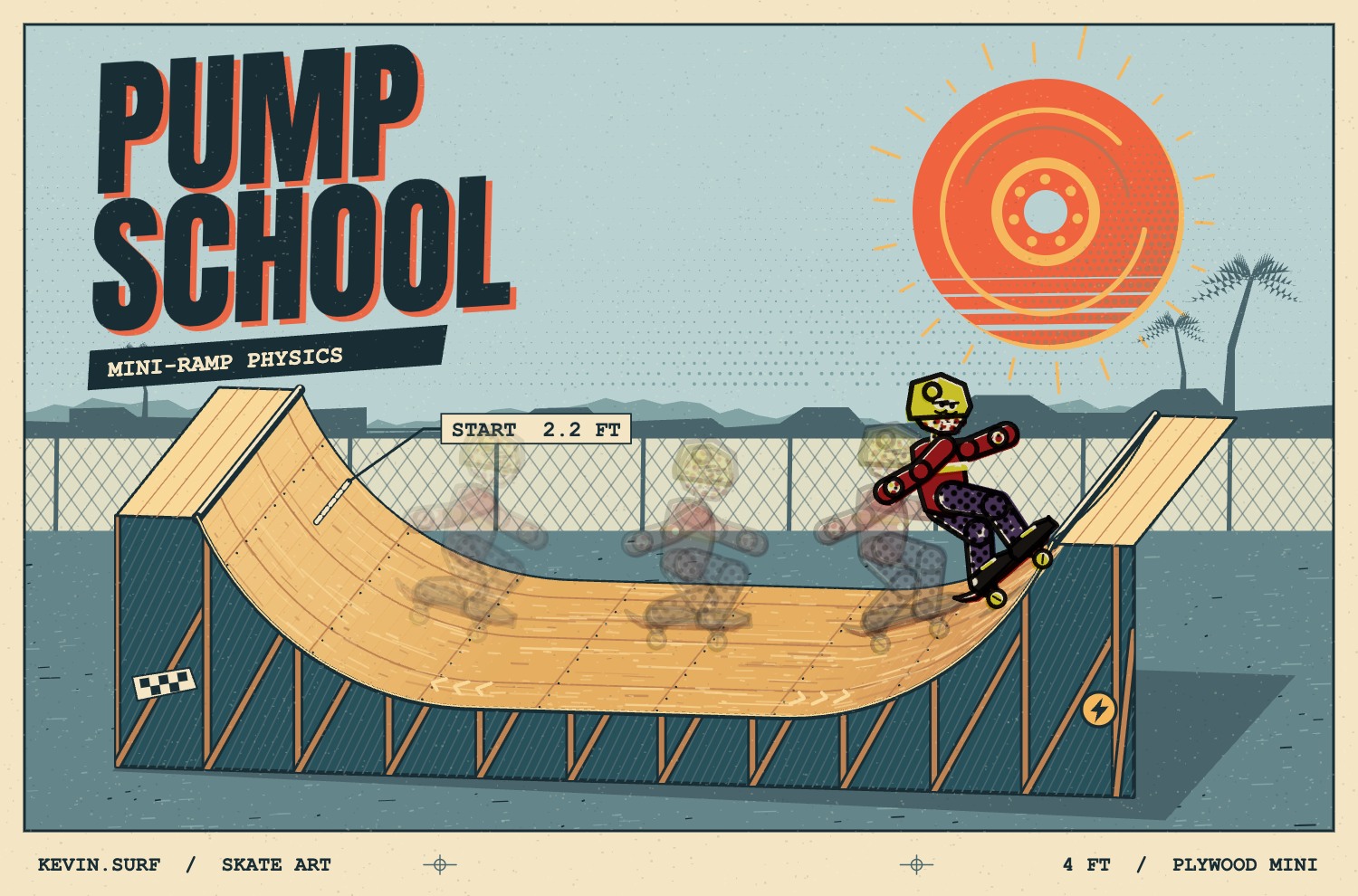
Plywood, two walls, zero pushes. Pump your way to coping tricks — or shape your own ramp and pull a print.
Watch the knees. The rider gets low on the flat and pushes tall as the wheels meet the curve.
↓ Gravity ↗ Ramp push ↗ Pump surge
━ CoM arc ━ Inward pump ⋯ Crouched line
Pick a frame to freeze the ride.
Gravity trades height for speed on the way down. Bent knees leave room to extend on the next wall.
As the ramp turns the board upward, the rider straightens their legs. That muscle work adds energy to the run.
Speed turns back into height. A well-timed pump buys a higher mark. Reach the coping to link Rock-to-Fakies, Tail Stalls and Coping Pops.
Both walls are circular arcs joined by a flat. Turn on Trace pump path (CoM) to see the shortcut: extending your legs through the lower curve pulls your center of mass inward toward the arc’s center against centrifugal force, doing mechanical work that boosts tangential speed. On the flat, standing up adds zero forward speed.
The speed readout follows the rider along the ramp. Height is measured at the wheels. A chalk stripe marks your last high point (and gold diamonds along the front edge mark your pocket hits in Your turn). Reach the steel lip to trigger coping tricks, or drop in from the deck with full potential energy. Read the skateboard pumping study ↗